

Your marketing team publishes a social media post comparing your service to a competitor’s. A former employee makes a critical comment about a customer online. Your graphic designer uses a stock image without the right license for an ad campaign. Your property manager sends an eviction notice to the wrong tenant.
None of these involve a slip-and-fall. No one has a broken bone. But every single one of them can result in a lawsuit that costs your business tens of thousands of dollars in legal fees alone even if the claim against you turns out to be entirely groundless.
This is where personal and advertising injury (P&AI) coverage steps in. Known in commercial insurance as Coverage B of your Commercial General Liability (CGL) policy, it’s the component most business owners don’t think about until they need it. In 2026, as businesses of every size maintain active digital presences, run social media advertising, and operate in fiercely competitive markets, P&AI has quietly become one of the most frequently triggered coverage components of a general liability policy.
Here we’ll explain exactly what personal and advertising injury coverage covers, what it doesn’t, how its limit works, and which businesses face the greatest exposure.
Know Your Policy:
Personal and advertising injury coverage is formally labeled ‘Coverage B’ in a standard Commercial General Liability (CGL) policy. Bodily injury and property damage is Coverage A. Most business owners know about Coverage A. Coverage B is where many unexpected lawsuits land.
What Is Personal and Advertising Injury Coverage?
Personal and advertising injury (P&AI) coverage protects your business from liability claims arising from non-physical harm your business causes to another person or entity. Unlike bodily injury and property damage coverage, which responds to physical accidents, P&AI responds to reputational, intellectual property, and privacy violations harms that stem from your words, marketing activities, and business conduct.
The coverage is split into two components that always appear together:
- Personal injury coverage: Protects against violations of an individual’s personal rights defamation, false arrest, wrongful eviction, invasion of privacy, and malicious prosecution.
- Advertising injury coverage: Protects against harm caused specifically through your advertising activities copyright infringement in ads, slogan theft, trade dress misappropriation, and misrepresentation in marketing content.
Both components share a single dedicated limit the personal and advertising injury limit which operates separately from your per-occurrence bodily injury and property damage limit. This means a P&AI claim draws from its own pool of coverage without affecting your Coverage A limits, and vice versa.
Personal Injury vs. Advertising Injury: What Each Component Covers
The distinction between personal injury and advertising injury within this coverage is important not just for understanding your policy, but for understanding where your business’s actual exposure lies. The table below breaks down what falls under each component:
Personal & Advertising Injury Coverage Component Breakdown
| 🔵 Personal Injury Coverage | 🟣 Advertising Injury Coverage |
|---|---|
| Defamation libel (written) or slander (spoken) about a person or competitor | Copyright infringement in your ads, unlicensed images, music, or text |
| False arrest or wrongful detention of a customer | Slogan or trade dress theft, copying another brand’s distinctive marketing |
| Malicious prosecution a groundless legal claim you initiated against someone | Misappropriation of advertising ideas, using a competitor’s creative concept |
| Wrongful eviction or unlawful entry (property owners/landlords) | Privacy violations occurring within your advertising or marketing content |
| Invasion of privacy publicly disclosing private facts about a person | Trade libel, false statements that harm a competitor’s product reputation |
| Using someone’s name, image, or likeness without permission (non-ad context) | Trademark-adjacent infringement tied to your advertising activities |
Real-World Scenarios: When Does P&AI Coverage Respond?
Understanding this coverage in the abstract is one thing seeing exactly how it applies to real business situations makes the exposure much clearer. Here are common P&AI claim scenarios that small and mid-size businesses actually face:
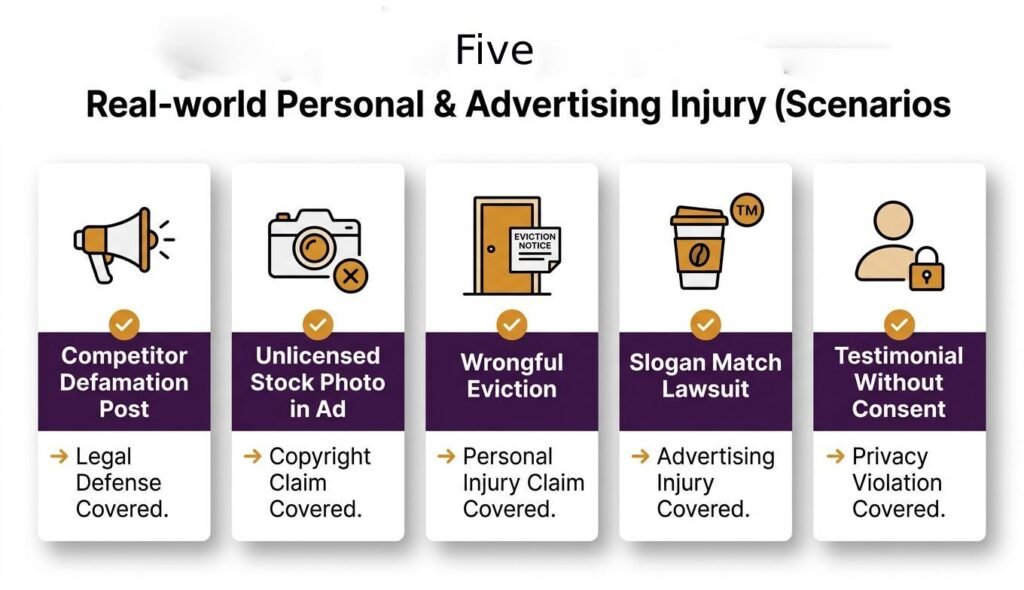
1: The Competitor Defamation Post
Your sales manager posts on your company’s LinkedIn page that a competing firm’s services are ‘dangerous and unregulated.’ The competitor sues your business for trade libel. a written false statement that harms their business reputation. Even if your manager believed what they wrote, proving truth in court is expensive. P&AI covers your legal defense and any resulting settlement up to your policy limit.
2: The Unlicensed Stock Photo
Your marketing team uses a photo found through a Google Image search in a Facebook ad campaign. Three months later, the photographer’s licensing agency sends a copyright infringement notice demanding $18,000 in damages. This is one of the most common P&AI claims in the digital era. Your advertising injury coverage responds to the legal costs and the settlement demand.
3: The Wrongful Eviction
A property management company sends a notice of eviction to a commercial tenant who has not, in fact, violated their lease terms. The tenant sues for wrongful eviction. P&AI’s personal injury component covers wrongful eviction claims providing both legal defense and coverage for any damages awarded.
4: The Accidental Slogan Match
A small coffee shop launches a new branding campaign with the tagline ‘Born Strong, Brewed Bold.’ An established regional chain claims the tagline is too similar to their protected slogan and files suit for trade dress infringement. The coffee shop’s advertising injury coverage pays for defense counsel and any settlement potentially saving the business from a devastating legal judgment it had no budget to fight.
5: The Customer Testimonial Without Consent
A wellness business publishes a client before-and-after testimonial on its website and in paid ads without obtaining written consent. The former client claims invasion of privacy and unauthorized use of their likeness and demands damages. P&AI responds and pays for the lawsuit that most business owners assume couldn’t possibly happen to them.
Digital Reality Check:
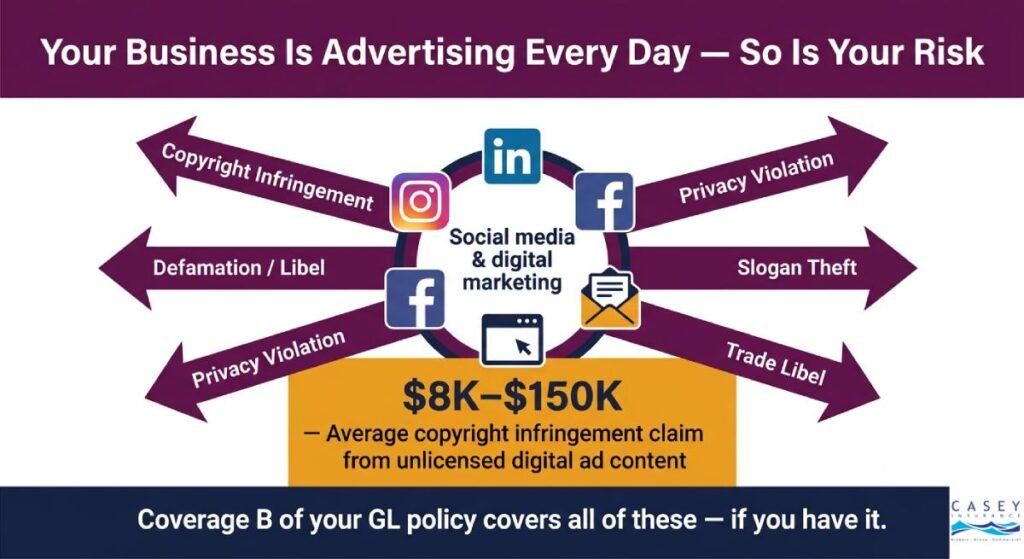
Copyright infringement is now the most commonly filed advertising injury claim for small businesses driven almost entirely by unlicensed images used in digital ads and social media posts. A single stock image used without proper licensing can generate a claim of $8,000 to $150,000 depending on usage scope and the rights holder.
What Personal & Advertising Injury Coverage Does NOT Cover
This is where many businesses discover an unwelcome surprise at claims time. P&AI is a broad but enumerated coverage it only responds to the specific offenses defined in your policy form. Common and important exclusions include:
Personal & Advertising Injury Coverage Covered vs. Not Covered
| ✅ What P&AI COVERS | ❌ What P&AI Does NOT Cover |
|---|---|
| ✅ Accidental use of unlicensed image in a social ad | ❌ Intentional use of copyrighted content after receiving a cease & desist |
| ✅ Employee makes a false verbal statement about a competitor | ❌ False advertising claims — e.g., overstating product performance specs |
| ✅ Customer wrongfully detained by your security team | ❌ Employment-related defamation (covered by EPLI, not GL) |
| ✅ Competitor sues over a slogan your marketing team accidentally copied | ❌ Patent infringement — not covered under standard CGL policies |
| ✅ Landlord sued for wrongful eviction of a commercial tenant | ❌ Businesses in media, publishing, or content creation as core services |
| ✅ Social media post that constitutes trade libel against a competitor | ❌ Prior publication — content published before the current policy period |
| ✅ Legal defense costs even for groundless or frivolous lawsuits | ❌ Knowing violation of another party’s rights (must be unintentional) |
The False Advertising Exclusion Important for Product Businesses
A frequently misunderstood exclusion: false advertising making intentionally misleading claims about your own products or services is explicitly excluded from P&AI. If your business advertises that a product performs at a level it cannot actually achieve, any resulting claims are not a P&AI matter. This exclusion exists because P&AI is designed to cover accidental, unintentional violations not marketing fraud.
P&AI vs. Professional Liability (E&O) Know the Boundary
Business owners sometimes confuse P&AI with professional liability (Errors & Omissions) coverage. The distinction is clear: P&AI covers reputational, privacy, and intellectual property violations that arise from your business conduct and marketing. Professional liability covers financial harm caused by errors in your professional advice or services. A consultant who writes a defamatory comparison blog needs P&AI. A consultant whose bad advice costs a client money needs E&O. Many businesses need both they address entirely different risk categories.
See our breakdown of general liability vs. professional liability insurance for a full comparison.
Understanding Your Personal & Advertising Injury Limit
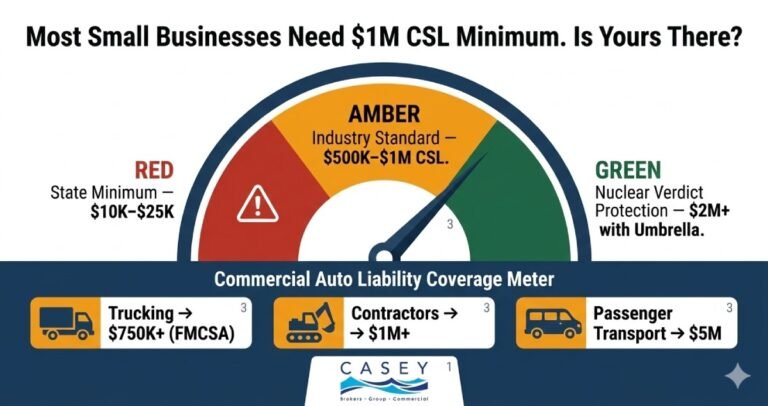
Most standard GL policies set the personal and advertising injury limit equal to the per-occurrence bodily injury and property damage limit typically $1,000,000 per claimant. This limit is separate from your general aggregate and operates independently of your Coverage A limits.
What this means in practice:
- A P&AI claim of $400,000 does not reduce the amount available for future bodily injury claims within the same policy year
- Multiple P&AI claims in a single year each draw against the same $1M limit each claimant has access to the full per-claimant limit, but your insurer’s total exposure across all P&AI claims is capped at your aggregate
- Some insurers are beginning to fold P&AI into a combined ‘Liability and Medical Expenses’ limit confirm with your advisor whether your P&AI has its own dedicated limit or shares a pool with other coverages
For businesses in competitive markets, those with active digital advertising, or those in industries with high IP exposure, the standard $1M P&AI limit may be insufficient. A commercial umbrella policy is the most efficient way to extend P&AI limits above the primary GL level without restructuring your entire policy.
Limit Watch:
Legal defense costs in a P&AI claim often represent 40–60% of total claim costs even when the lawsuit is ultimately dismissed. A $1M P&AI limit can be eroded quickly by defense fees in complex IP or defamation litigation. Review your limits annually with your advisor, especially if your advertising spend or digital presence has grown significantly.
Which Businesses Face the Highest Personal & Advertising Injury Exposure?
Every business with a GL policy has some level of P&AI coverage but not every business faces the same level of exposure. The table below maps industry risk profiles to help you assess where your business sits:
P&AI Exposure by Business Type — 2026 Risk Reference
| Business Type | P&AI Risk Level | Primary Exposure |
|---|---|---|
| Retail / E-Commerce | Moderate | Regular social media + product advertising creates copyright and trade dress risk |
| Restaurants / Food & Beverage | Moderate–High | Competitor disparagement, menu slogan claims, social media defamation exposure |
| Marketing / Advertising Agencies | Very High* | Core business is content — standard CGL P&AI may be insufficient; media E&O needed |
| Consulting / Professional Services | Moderate | Comparison content, competitor references in proposals and blog posts creates risk |
| Real Estate / Property Management | High | Wrongful eviction, unauthorized entry, tenant defamation claims are routine exposure |
| Contractors / Trades | Low–Moderate | Advertising activity is limited but social media presence increases defamation risk |
| Healthcare / Wellness | Moderate | Patient privacy, testimonial misuse, competitor claims around treatments |
| Tech / SaaS Companies | High | IP-heavy competitive landscape — slogan and trade dress claims are common |
5 Ways to Reduce Your Personal & Advertising Injury Exposure
Insurance is the financial backstop but the best P&AI strategy combines coverage with proactive risk management. Here are the most effective practices:
- License all creative assets formally: Use reputable stock libraries (Getty, Shutterstock, Adobe Stock) with documented licenses. Never use images found through search engines without verifying rights. This eliminates the single largest source of advertising injury claims for small businesses.
- Train your team on social media conduct: Every employee with access to a business social account is a potential P&AI liability. Establish a written social media policy that prohibits comparative disparagement, unverified factual claims about competitors, and sharing of third-party content without attribution.
- Obtain written consent for testimonials and likeness use: Before publishing a customer quote, photo, or before-and-after case study in any marketing material online or print secure signed written consent that specifies how the content will be used.
- Trademark your own brand assets: Registering your business name, slogan, and logo with the USPTO gives you documented prior claim to your brand identity and dramatically strengthens your position if another party claims you’ve infringed on their mark.
- Review advertising materials before publication: For major campaigns, involve a legal reviewer who can identify comparative claims, factual representations, and imagery rights issues before the content goes live not after a cease-and-desist arrives.
Does a Business Owners Policy (BOP) Include Personal & Advertising Injury Coverage?
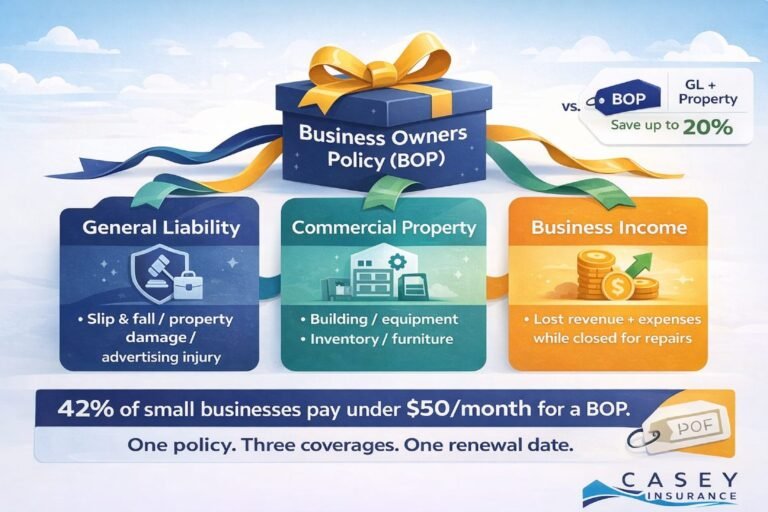
Yes personal and advertising injury coverage is included as a standard component of a Business Owners Policy (BOP). A BOP bundles GL (including Coverage B P&AI), commercial property, and business income protection making it the most cost-efficient way for most small businesses to carry this coverage alongside their other essential protections.
If your current BOP includes GL, your P&AI coverage is already active. What many BOP policyholders don’t check and should is their specific P&AI limit, whether any industry-specific endorsements have narrowed the coverage scope, and whether a commercial umbrella or optional endorsement might be appropriate given the nature and volume of their advertising activity.
FAQs About Personal and Advertising Injury Coverage
P&AI coverage formally Coverage B of your GL policy covers liability claims arising from defamation (libel and slander), copyright infringement in your advertising, slogan or trade dress theft, invasion of privacy, wrongful eviction (for landlords), false arrest, and malicious prosecution. It covers legal defense costs, settlements, and judgments up to your policy limit, even for unfounded or groundless claims. It does not cover intentional acts, false advertising, employment-related defamation, or patent infringement.
Yes defamation, including both libel (written statements) and slander (spoken statements), is one of the core covered offenses under the personal injury component of your GL policy’s Coverage B. If your business, your employees, or your advertising content makes false statements that harm another person or business’s reputation, your P&AI coverage pays for legal defense and any resulting damages subject to your policy limit and the exclusion for intentional acts.
Yes, your P&AI limit is a separate, dedicated limit from your bodily injury and property damage per-occurrence limit. Most standard GL policies set the P&AI limit at $1,000,000 per claimant, separate from the general aggregate. A P&AI claim does not reduce your Coverage A limits for the same policy year. Some carriers are beginning to combine limits always review your declarations page and confirm your P&AI has its own dedicated limit or understand the combined structure.
Generally, no — and this is a critical point for content-focused businesses. Standard CGL P&AI is explicitly limited or excluded for businesses whose primary service is media, content creation, publishing, or advertising. Marketing agencies, PR firms, digital content studios, and similar businesses typically need Media Liability (Advertising E&O) insurance — a specialized policy that covers the significantly higher IP and content-related exposure these businesses carry. Using a standard GL policy’s P&AI limit as the only coverage for an agency is a serious and common gap.
Don’t Let a Social Post, an Ad, or a Lease Dispute Become Your Biggest Business Expense
In 2026, personal and advertising injury exposure follows every business into the digital world. Every post, every ad campaign, every marketing email, and every contract is a potential Coverage B event and the businesses that understand their P&AI protection before a lawsuit arrives are the ones that survive it financially intact.
Our commercial insurance advisors help businesses across Florida and nationwide ensure their GL policies include robust, properly structured personal and advertising injury protection. Explore our personal and advertising injury coverage service, review our full general liability insurance options, and learn how a Business Owners Policy bundles this protection alongside your other essential coverages or contact us for a personalized coverage assessment today.