

Every general liability insurance policy is built on two foundational pillars: bodily injury liability and property damage liability. Together, they form the core of commercial liability protection for small businesses yet many business owners don’t fully understand where one ends and the other begins, what each specifically covers, and more importantly what each one does not cover.
That gap in understanding is costly. According to data from the 2025 National Small Business Risk Index, the average small business liability claim now costs $97,200 and 1 in 3 small businesses do not have adequate coverage in place to withstand it. A single slip-and-fall accident, a contractor’s accidental property damage on a job site, or a product-related injury can trigger a claim that drains years of operating reserves or forces a business to close entirely.
Here we’ll breaks down both coverages in detail what they pay for, what they exclude, how their limits work, and how to determine how much protection your business actually needs in 2026.
Key Distinction:
Bodily injury (BI) liability covers physical harm caused to third parties customers, clients, bystanders. Property damage (PD) liability covers damage your business causes to someone else’s property. These are separate coverage components with separate limits, even within the same GL policy.
Bodily Injury vs. Property Damage
Before diving into each coverage individually, it helps you to see how they compare directly. Both fall under your general liability policy, but they respond to completely different types of incidents:
Bodily Injury vs. Property Damage Liability — At a Glance
| 🔵 Bodily Injury Liability (BI) | 🟢 Property Damage Liability (PD) |
|---|---|
| Covers physical harm to third parties — customers, clients, visitors, bystanders | Covers damage your business causes to someone else’s property |
| Pays medical bills, lost wages, pain & suffering of the injured party | Pays repair or replacement cost of the damaged property |
| Covers legal defense if the injured person sues your business | Covers legal defense if the property owner sues your business |
| Applies to incidents on your premises AND caused by your operations off-site | Applies to damage caused on client property, job sites, or during operations |
| Does NOT cover your own employees (that’s workers’ comp) | Does NOT cover your own business property (that’s commercial property) |
| Example: Customer trips on loose carpet in your store → BI responds | Example: Contractor’s crew cracks a client’s countertop → PD responds |
What Is Bodily Injury Liability? A Complete Explanation
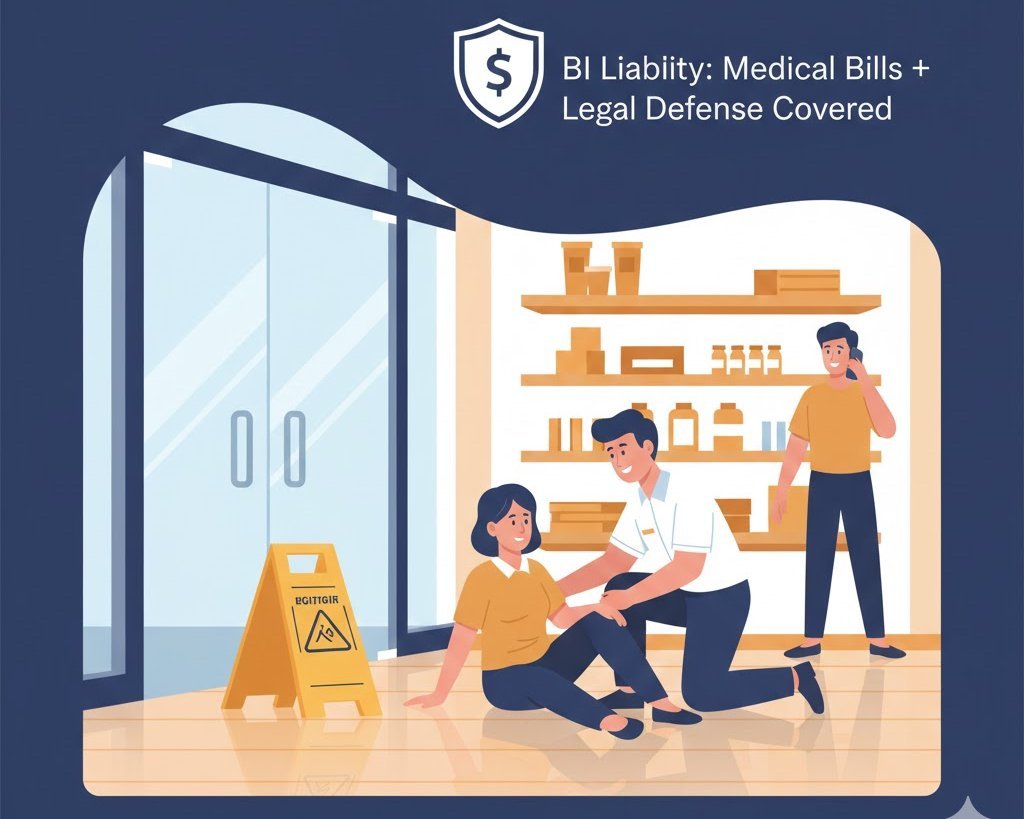
Bodily injury liability (BI) is the component of your general liability policy that pays for physical harm your business causes to a third party. ‘Third party’ means anyone who is not your employee customers, clients, delivery personnel, visitors, passersby, or any member of the public who interacts with your business operations.
When a covered bodily injury incident occurs, your BI liability coverage pays for:
- Medical expenses: Emergency treatment, hospitalization, surgery, physical therapy, prescription medications, and any ongoing care resulting from the injury.
- Lost wages: Compensation to the injured person for income they’re unable to earn while recovering from the injury your business caused.
- Pain and suffering: Non-economic damages the injured party may claim, which are often the largest component of a bodily injury settlement.
- Legal defense costs: Attorney fees, court costs, and related expenses even if the claim against your business is entirely groundless or fraudulent.
- Settlements and judgments: Amounts your business is legally required to pay as a result of a bodily injury lawsuit, up to your policy limits.
Bodily Injury Liability Coverage: Real-World Scenarios
BI liability responds to a wide variety of incidents across virtually every business type. Here are the most common coverage scenarios:
- Premises liability (slip-and-fall): A customer trips on an uneven threshold in your office and fractures their ankle. Your BI coverage pays their medical bills, lost wages, and any legal claim. The average slip-and-fall claim costs between $20,000 and $97,000 depending on injury severity.
- Off-premises operations: Your HVAC technician is servicing a client’s building when a tool falls from a ladder and strikes a passerby. BI covers that injury your liability doesn’t stop at your front door; it follows your operations.
- Products liability: A customer purchases a product your store sold and is injured by a defect. If you sold it, your BI coverage responds even if you didn’t manufacture it. This is part of why products and completed operations coverage is a critical GL component for product-based businesses.
- Completed work liability: A contractor finishes a deck installation, and a family member falls through a structural flaw three months later. Your BI coverage responds to that post-completion injury claim.
Claim Reality Check:
One bodily injury claim regardless of fault increases your GL premium by 25% to 50% for three to five years. (MoneyGeek, 2026) A documented workplace safety program, clear signage, and regular premises inspections aren’t just good business practices they’re premium management tools.
What Bodily Injury Liability Does NOT Cover
Understanding the exclusions is where many business owners get into trouble:
- Your own employees: Injuries to employees are explicitly excluded from BI liability coverage. That’s the domain of workers’ compensation insurance a separate, legally required policy in most states.
- Intentional harm: If a business owner or employee intentionally injures someone, the GL policy will not respond. Coverage requires that the injury be accidental.
- Professional errors: If a client claims your professional advice or service caused them physical or financial harm, that’s a professional liability (E&O) claim not a BI claim.
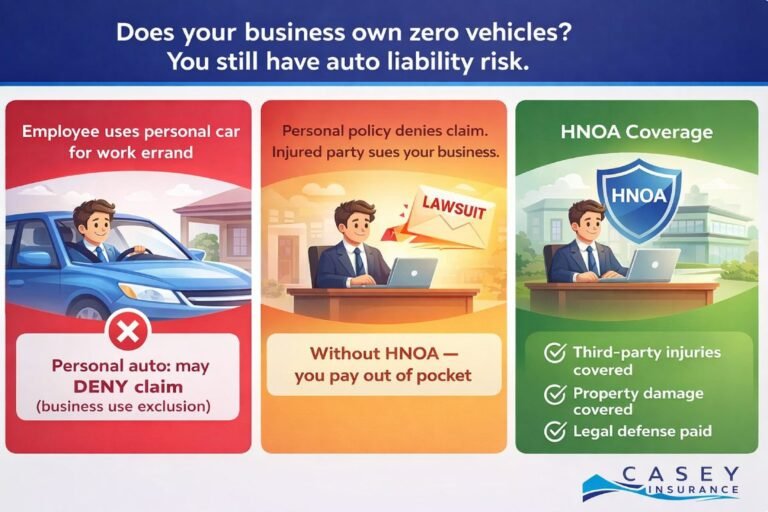
- Auto accidents: Bodily injury caused by a vehicle operated for business purposes is covered by your commercial auto liability policy not your GL policy.
- Pollution or environmental damage: Most standard GL policies include a pollution exclusion. Contractors and certain industrial operations may need a separate environmental liability policy.
What Is Property Damage Liability? A Complete Explanation
Property damage liability (PD) covers the cost of damage your business causes to someone else’s property during the course of your operations. It doesn’t matter whether the damage happened at your location, at a client’s premises, or somewhere in between if your business was responsible, your PD coverage responds.
When a covered property damage incident occurs, PD liability pays for:
- Repair costs: The cost to fix damaged property to its pre-loss condition, including labor and materials.
- Replacement costs: When property is damaged beyond repair, PD pays to replace it with an equivalent item at current value.
- Loss of use: If the damaged property was income-producing and the owner loses revenue while it’s being repaired, PD may cover that economic loss.
- Legal defense: Attorney fees and court costs if the property owner sues your business for the damage, up to policy limits.
Property Damage Liability Coverage: Real-World Scenarios
Property damage liability is particularly critical for any business that works on or inside clients’ properties or operates in environments where third-party assets are present:
- Service businesses on client property: A cleaning crew accidentally knocks over and shatters an expensive display piece in a client’s office. PD covers replacement. A plumber’s incorrect installation causes water damage to a client’s kitchen. PD responds.
- Construction and trades: A subcontractor’s equipment damages an adjacent property’s fence and landscaping. PD covers the repair costs and any legal claim from the neighboring property owner.
- Landscaping and exterior services: A lawn care crew accidentally breaks a client’s irrigation system or drives heavy equipment over a buried utility line. PD covers the damage.
- Retail and product-based businesses: A delivered appliance damages a customer’s flooring during installation. If your team handled the delivery and installation, your PD coverage applies.
- Advertising and media: If your business’s operations cause physical damage to a third-party’s tangible property, PD responds even in less obvious scenarios like a broadcast tower malfunction damaging adjacent property.
For a complete breakdown of how property damage liability is structured within your GL policy, visit our property damage liability coverage page.
What Property Damage Liability Does NOT Cover
- Your own property: PD only covers damage to other people’s property. Damage to your own business equipment, inventory, or building is covered by commercial property insurance or a BOP — not GL.
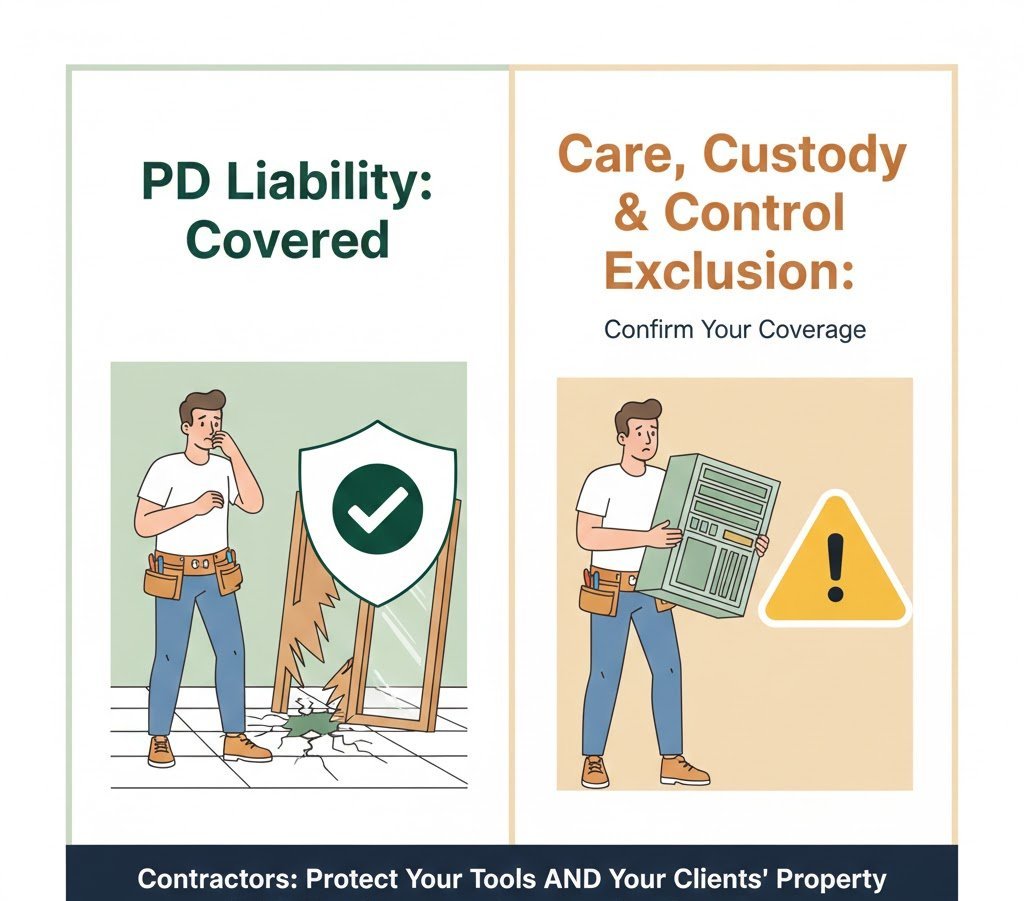
- Property in your care, custody, or control (CCC): This is a critical and frequently misunderstood exclusion. If a client leaves their property in your possession and it’s damaged, standard GL may not cover it under the CCC exclusion. Contractors who routinely work with client property should ask about a ‘care, custody, or control’ endorsement or bailee coverage.
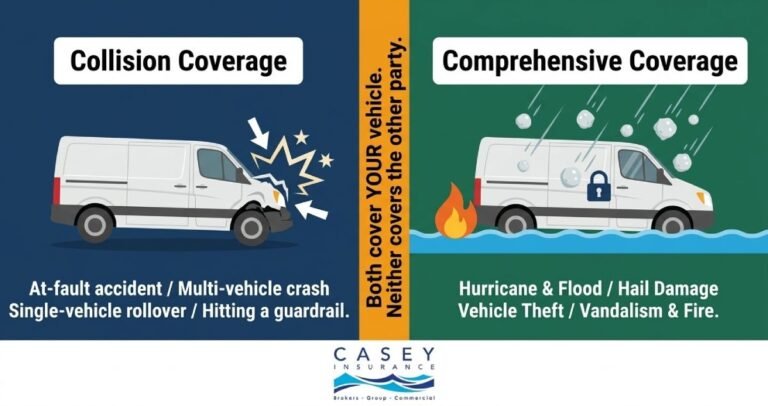
- Vehicle damage: Damage caused by your business vehicle to another vehicle or property is covered under commercial auto liability not your GL property damage component.
- Intentional damage: Deliberate or willful destruction of property is excluded. PD responds to accidental damage only.
- Contractual liability beyond standard obligations: If you’ve contractually assumed liability for property damage beyond what tort law would impose, additional contractual liability coverage may be needed.
The CCC Exclusion Warning:
The ‘care, custody, or control’ exclusion catches many service businesses off guard. If you’re a contractor, repair technician, or service provider who regularly has client property in your possession, confirm with your advisor whether your GL policy covers damage to that property or whether you need a separate endorsement.
Is Your Incident Covered? A Scenario Reference Guide
Use this table as a quick-reference guide for common business incidents and which liability coverage applies:
BI & PD Liability: Real-World Scenario Coverage
| Incident Scenario | Coverage Type | What the Policy Covers |
|---|---|---|
| Customer slips on wet floor in your store, breaks wrist | BI ✅ | ER visit, surgery, lost wages — covered. Slip-and-fall avg: $20K–$97K |
| Employee knocks over client’s antique vase on a service call | PD ✅ | Replacement value of the vase — covered under PD |
| Food delivery driver (your employee) hits a parked car | PD ✅ / BI ✅ | Vehicle damage = PD. Injuries to other driver = BI (via commercial auto) |
| Child injured by a product your store sold after leaving premises | BI ✅ | Products liability under GL — covered if injury linked to your product |
| Landscaper accidentally damages client’s irrigation system | PD ✅ | Repair/replacement cost — covered. Client property damage on the job |
| Visitor injured by falling equipment at your construction site | BI ✅ | Medical costs + legal defense — covered. High-risk scenario for contractors |
| Your own employee injured on the job | Neither ❌ | This is workers’ compensation — a separate required policy |
| Fire at your own office destroys your equipment | Neither ❌ | Commercial property coverage — not GL. BI/PD protect third parties only |
How Much Bodily Injury and Property Damage Liability Do You Need?
This is one of the most important questions a business owner can ask and one of the most frequently answered incorrectly. The instinct to pick the lowest available limit to minimize premium is understandable, but it can be financially catastrophic. With the average liability claim now costing $97,200, a $300,000 policy limit that was set when the business launched may leave you personally responsible for the difference after the policy pays out.
Recommended BI & PD Liability Limits by Business Type — 2026
| Business Type | Recommended BI Limit | Recommended PD Limit | Advisor Notes |
|---|---|---|---|
| Low-Risk (Consultants, IT, Admin) | $500K–$1M per occurrence | $10K–$100K | Standard $1M/$2M GL usually sufficient |
| Retail / Food Service | $1M per occurrence | $100K–$500K | Slip-and-fall exposure warrants full $1M/$2M GL |
| Cleaning / Janitorial | $1M per occurrence | $300K–$500K | Regular on-site property damage risk — don’t underinsure PD |
| General Contractors | $1M–$2M per occurrence | $500K–$1M | Consider commercial umbrella for contracts requiring $2M+ |
| Roofing / High-Risk Trades | $2M per occurrence | $1M | Severe injury risk — umbrella strongly recommended |
| Manufacturers / Product Sellers | $1M–$2M per occurrence | $500K | Products & completed operations exposure — higher BI limits |
| Restaurants / Bars | $1M per occurrence | $500K | High public interaction + liquor liability exposure — review aggregate |
Understanding Your BI/PD Limits: Per-Occurrence vs. Aggregate
Your GL policy will show two key limit figures that govern BI and PD coverage:
- Per-occurrence limit: The maximum your insurer pays for any single incident. The standard for most small businesses is $1,000,000.
- Aggregate limit: The total maximum across all claims during the policy year. The standard aggregate is $2,000,000 meaning your policy can respond to multiple incidents up to that combined annual total.
- Products & completed operations aggregate: A separate aggregate specifically for product liability and post-completion claims particularly important for contractors and product-based businesses.
If your business operations, client contracts, or risk profile demand higher limits than the standard $1M/$2M structure, a commercial umbrella policy is the most cost-efficient way to extend your BI and PD limits. An umbrella typically provides an additional $1M–$5M in coverage above your primary GL policy at a relatively modest additional premium.
Bodily Injury & Property Damage Liability in Florida: What’s Different
Florida business owners face some unique considerations when it comes to BI and PD liability coverage both within their GL policies and for commercial vehicles.
Florida’s GL Litigation Environment
Florida has historically been one of the most litigious states in the country for liability claims, with California, Florida, Texas, and New York consistently recording the highest average claim costs nationally. Despite tort reform efforts including HB 837 in 2023, which modified several aspects of civil liability law Florida’s commercial liability environment remains above average in both claim frequency and severity.
For Florida-based businesses, this means two things practically: your GL premiums will typically be higher than the national average, and the importance of carrying adequate limits (not just minimum limits) is amplified.
Florida Commercial Auto: BI & PD Requirements
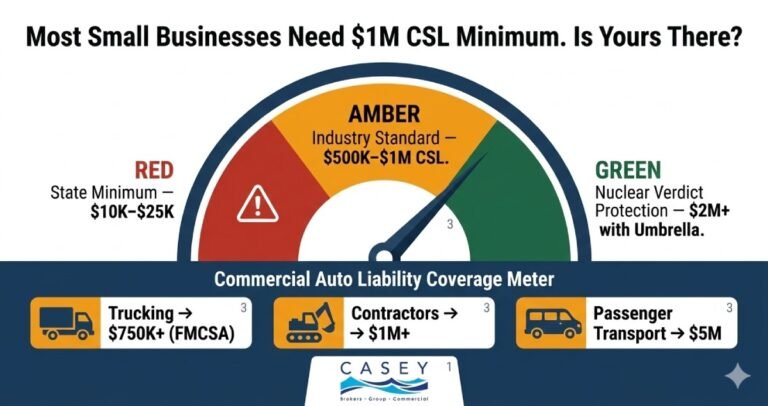
Florida’s commercial auto BI and PD requirements are worth understanding separately from GL. For commercial motor vehicles operating in Florida, the state requires bodily injury liability coverage of at least $10,000 per person / $20,000 per incident and property damage liability of at least $10,000 per vehicle. Pending legislation (HB 1181) may increase the BI minimum to $25,000/$50,000 effective July 1, 2026 consult a Florida-licensed advisor for the current requirement at time of purchase.
However, these are absolute legal minimums not recommended limits. A serious commercial vehicle accident with multiple injuries can easily exceed $1M in combined BI and PD claims. Most Florida commercial insurance advisors recommend significantly higher limits or a commercial umbrella for any business operating vehicles. See our overview of auto liability insurance and how much coverage you need for further detail.
Is Bodily Injury Liability Required in Florida for Businesses?
For commercial general liability policies, Florida law does not mandate a specific BI liability minimum for most businesses but many industries, licensing boards, and contracts impose their own requirements. Florida contractors, for example, are required to carry GL coverage (including BI) as a condition of their state license.
For commercial auto, as noted above, minimums apply and may increase in 2026. The takeaway for Florida business owners: even where BI is not legally mandated, operating without it in Florida’s legal environment creates substantial personal financial exposure that most businesses cannot afford to absorb.
How BI & PD Liability Fits Into a Business Owners Policy (BOP)
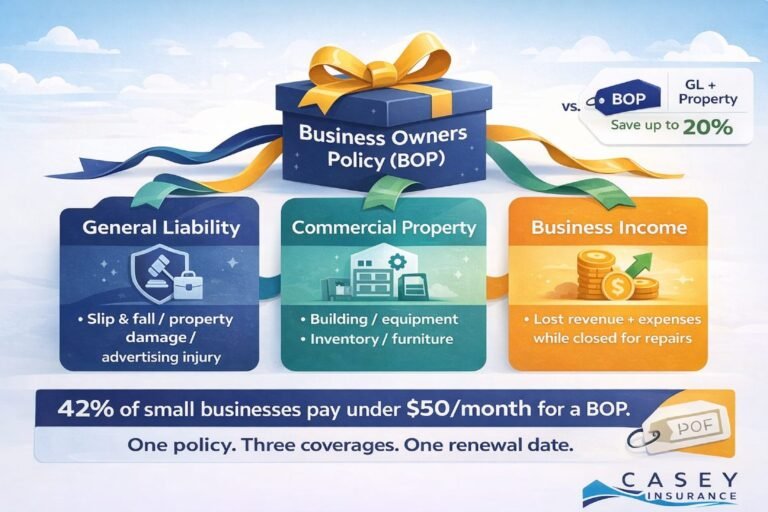
For most small and mid-size businesses, the most cost-efficient way to carry BI and PD liability coverage is through a Business Owners Policy (BOP). A BOP bundles general liability (which includes your BI and PD components) with commercial property coverage and business income protection typically at a lower combined premium than purchasing each separately.
The GL component of a BOP provides the same BI and PD liability protection as a standalone GL policy, and can be enhanced through optional endorsements to address coverage gaps like the care, custody, and control exclusion, hired and non-owned auto, and data breach liability.
If your business qualifies for a BOP (most small-to-mid-size businesses outside of high-risk industries do), it is typically the most financially efficient entry point for comprehensive BI and PD liability protection.
FAQs About Bodily Injury & Property Damage Liability
Bodily injury liability covers medical expenses, lost wages, pain and suffering, and legal defense costs when a third party (non-employee) is physically injured as a result of your business operations. It responds in scenarios like a customer slip-and-fall on your premises, a visitor injured by your equipment at a job site, a bystander hurt during your operations off-site, or an injury caused by a product you sold. It does not cover your own employees (workers’ comp), vehicle accidents (commercial auto), or professional errors (E&O).
The standard for most small businesses is $1,000,000 per occurrence / $2,000,000 aggregate. This satisfies most landlord, client, and licensing requirements. Higher-risk industries construction, food service, manufacturing, healthcare should carry at least $1M/$2M and seriously consider a commercial umbrella policy for additional protection.
For most Florida businesses, bodily injury liability under a commercial GL policy is not specifically mandated by state law but it is effectively required in practice. Florida contractor licensing rules require GL coverage (including BI). Most commercial leases and client contracts require it. And operating in Florida’s above-average litigation environment without BI coverage exposes your personal assets and business finances to claims that can easily exceed $100,000. For commercial vehicles, Florida law does mandate BI minimums, which may increase to $25,000/$50,000 per pending 2026 legislation.
The care, custody, and control exclusion prevents your GL property damage coverage from responding when you damage property that has been entrusted to your business such as a client’s equipment left with you for repair, a vehicle left at your shop, or a client’s property temporarily in your possession at a job site. This exclusion surprises many contractors and service businesses.
Make Sure Your BI & PD Coverage Is Actually Built for Your Business
Bodily injury and property damage liability aren’t abstract insurance concepts they’re the financial defense system that determines whether a single accident ends your business or gets handled professionally and moved past. In 2026, with average claim costs approaching $100,000 and Florida’s litigation environment maintaining above-average pressure, the right limits and the right policy language matter more than ever.
Our commercial insurance advisors help businesses across Florida and nationwide structure general liability coverage with BI and PD limits that reflect actual risk not just minimum compliance. Whether you’re buying your first GL policy or reassessing whether your current limits are adequate, we’re here to help. Contact us for a customized coverage review today.