

Businesses often need proof that they carry insurance before signing contracts, starting projects, or working with clients. This proof is usually provided through a Certificate of Liability Insurance (COI).
Even you are a contractor, small business owner, vendor, or service provider, understanding how a certificate of liability insurance works can help you protect your business and meet contractual requirements.
Here we’ll will explain the COI meaning, what a COI is, what it includes, how much it costs, and how you can obtain one quickly.
What Is a Certificate of Liability Insurance?
A Certificate of Liability Insurance (COI) is a document issued by an insurance company or broker that confirms a business has active liability insurance coverage.
The certificate summarizes key details of the policy, including:
- Name of the insured business
- Insurance company providing coverage
- Policy number
- Types of coverage
- Policy limits
- Policy effective dates
The certificate of liability does not provide coverage itself. Instead, it acts as proof that coverage exists.
Businesses are commonly asked to provide a COI when:
- Signing a service contract
- Renting commercial space
- Working with large companies or government agencies
- Entering construction or vendor agreements
- Participating in events or exhibitions
Providing a COI helps assure the other party that your business carries insurance and can handle potential claims.
COI Meaning: What Does COI Stand For?
The abbreviation COI stands for “Certificate of Insurance.”
In many business situations, people specifically refer to a Certificate of Liability Insurance, which confirms liability coverage such as:
- General Liability Insurance
- Professional Liability Insurance
- Commercial Auto Liability
- Workers’ Compensation (in some cases)
When someone asks for a COI, they usually want proof that your company carries the necessary insurance coverage required for a project or partnership.
What Is Included in a Certificate of Liability Insurance?
A standard certificate of liability insurance contains several important sections that verify insurance coverage.
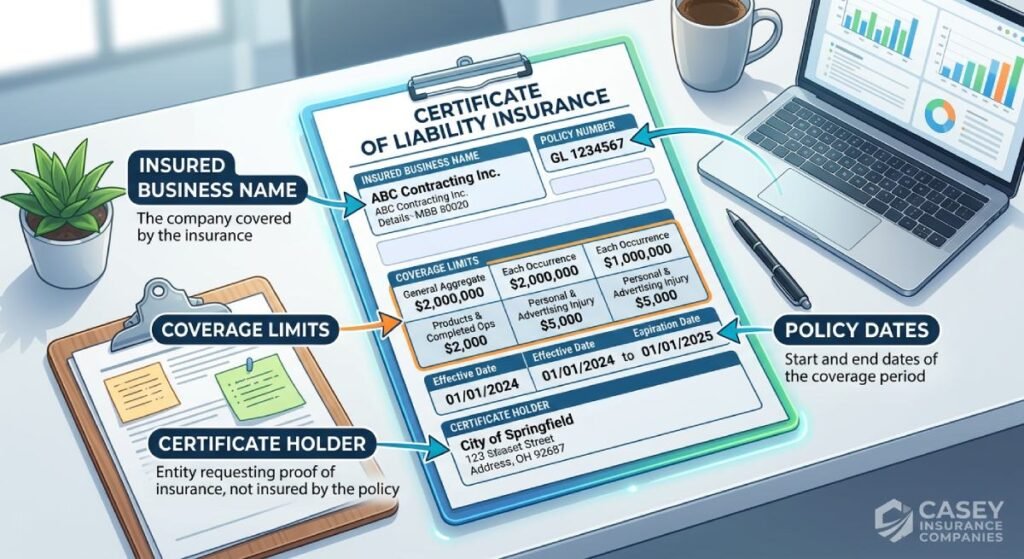
Typical information included on a COI:
1. Insured Business Information
The name and address of the business that holds the insurance policy.
2. Insurance Provider
The name of the insurance company providing coverage.
3. Policy Details
Policy number and effective coverage dates.
4. Types of Coverage
The certificate may list multiple coverage types, such as:
- General Liability
- Professional Liability
- Commercial Auto
- Workers’ Compensation
- Umbrella Liability
5. Coverage Limits
This section shows the maximum amount the insurer will pay for claims.
For example:
| Coverage Type | Example Limit |
|---|---|
| General Liability | $1,000,000 per occurrence |
| Products & Completed Operations | $2,000,000 aggregate |
| Personal & Advertising Injury | $1,000,000 |
6. Certificate Holder
The organization or individual requesting proof of insurance is listed as the certificate holder.
Why Do Businesses Need a Certificate of Liability Insurance?
Many companies require proof of insurance before working with contractors, vendors, or service providers.
A certificate of liability insurance protects all parties involved by confirming that insurance coverage is in place.
Common reasons a COI is required include:
1. Contract Requirements
Many business contracts require proof of liability coverage before work begins.
2. Risk Protection
If accidents or damages occur, the insurance policy helps cover financial losses.
3. Professional Credibility
Providing a COI demonstrates that your business is responsible and properly insured.
4. Compliance
Some industries or government projects require proof of insurance before granting permits or approvals.
How Much Does a COI Cost?
One of the most common questions business owners ask is:
How much does a COI cost?
In most cases, a Certificate of Liability Insurance is free.
Insurance companies typically provide COIs at no additional cost once you have an active insurance policy.
However, the cost depends on the insurance policy itself, not the certificate.
Typical liability insurance premiums vary depending on:
- Type of business
- Industry risk level
- Coverage limits
- Number of employees
- Business revenue
- Claims history
For example:
| Business Type | Estimated Annual Liability Premium |
|---|---|
| Small Consulting Business | $300 – $700 |
| Contractor / Construction | $1,000 – $5,000+ |
| Retail Store | $500 – $2,000 |
Once you have coverage, your insurer can usually issue a COI within minutes or hours.
How Do I Obtain a Certificate of Liability Insurance?
Obtaining a certificate of liability insurance is typically a simple process.
1: Purchase Liability Insurance
First, your business must have an active liability insurance policy.
Common policies include:
- General Liability Insurance
- Professional Liability Insurance
- Commercial Auto Insurance
- Workers’ Compensation
2: Contact Your Insurance Provider
You can request a COI directly from:
- Your insurance broker
- Your insurance company
- Your online insurance portal
3: Provide Certificate Holder Details
You may need to provide information about the company requesting the certificate, such as:
- Business name
- Address
- Special insurance requirements
4: Receive the COI
Your insurer will generate a Certificate of Liability Insurance showing your coverage details and send it via:
- Email (PDF)
- Online portal
- Printed document
Many insurers can provide COIs the same day.
When Should You Request a COI?
Businesses should request a COI whenever proof of insurance is required.
Common situations include:
- Starting a new contract or project
- Working as a subcontractor
- Leasing commercial property
- Providing services for large organizations
- Participating in events or trade shows
Keeping a COI ready can help avoid project delays.
No. A COI is only proof that insurance exists. The actual coverage is provided by the insurance policy itself.
Most insurance providers can issue a certificate of liability insurance the same day or within a few hours.
Final Thoughts
A Certificate of Liability Insurance (COI) is an essential document that verifies your business carries active insurance coverage.
It provides reassurance to clients, partners, and project managers that your company is protected against potential risks and claims.
Understanding the COI meaning, what it includes, how much it costs, and how to obtain it can help businesses operate more confidently and meet professional requirements.
If your business frequently works with clients, vendors, or contractors, having liability insurance and quick access to a COI can make the process of securing contracts much smoother.
At Casey Insurance Companies, we help businesses obtain the right insurance coverage and provide the documentation they need to operate with confidence.